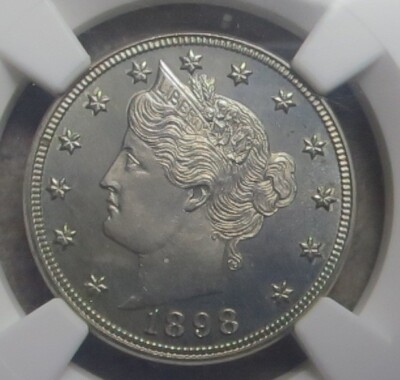
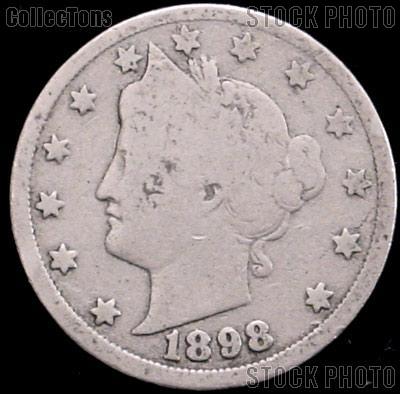
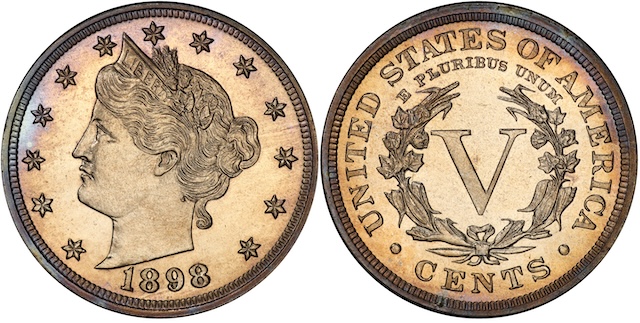
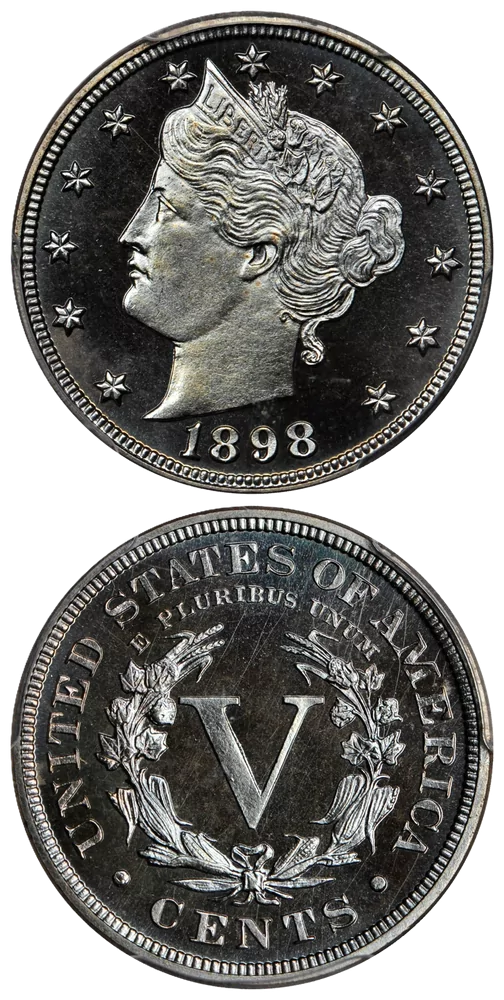
One gem-quality example sold for $9,988 at Legend Rare Coin Auctions — yet most circulated 1898 nickels start at just a few dollars. The gap between a worn example and a true Gem Uncirculated specimen is enormous, and knowing the difference puts real money in your pocket. This guide covers every value tier, the two PCGS-designated repunched date varieties, grading tips, and where to sell.
Select your coin's mint, condition, and any known errors below for an instant estimate.
If you're not yet sure about the mint mark or condition of your coin, there's a 1898 Liberty Nickel Coin Value Checker that lets you upload a photo and get an AI-assisted identification — a useful starting point before using the calculator above.
The FS-301 repunched date is the most sought-after variety on the 1898 Liberty nickel. Use this visual checker to see if your coin might qualify — a confirmed FS-301 in Gem condition has sold near $1,000.
Check all that apply to your coin:
The self-checker gives you a yes or no — but the calculator tells you the actual dollar range for your specific coin.
Get My Value Estimate →Jump to any section below — or scroll through for the complete picture.
The 1898 Liberty Head nickel was struck only in Philadelphia, but the die-making process produced at least seven documented variety listings for this date. The most significant are PCGS-designated repunched date (RPD) varieties, caused when mint workers punched the date numerals into the working die more than once — leaving ghost impressions of earlier strikes visible to the trained eye. Here are the five most collector-relevant varieties in descending value order.
The FS-301 is the signature variety of the 1898 Liberty Head nickel, designated by PCGS under their FS (Fivaz-Stanton) variety numbering as FS-014.49 in the older system. It was created when the date punch was first set into the working die showing the partial digits "189" and then repunched in the correct final position, leaving the ghost of the earlier attempt visible beneath the final numbers.
Visually, the most diagnostic feature is a secondary "8" or partial "9" visible below and slightly offset from the primary date. Under a 10× loupe, the base serifs of the primary "9" and final "8" show distinct doubled outlines. The shift is most pronounced in the second and third digit positions, making it easy to confirm once you know exactly where to look.
This variety commands a significant premium over the regular strike at every grade level. In Circulated grades (VF–AU), examples sell for $150–$300 above the regular-strike baseline. In MS-65 Gem condition, a confirmed FS-301 has crossed $999 at auction — nearly double the regular MS-65 price. Collector demand is driven by the variety's PCGS designation, easy visual recognition, and its status as one of the two most significant 1898 RPD listings.
The FS-302 is the second PCGS-designated die variety for the 1898 Liberty Head nickel, formerly listed as FS-014.495 in the older Fivaz-Stanton system. It is considered the rarer of the two PCGS-designated RPDs, resulting from not one but two additional date punches applied to the working die — creating a tripled impression of all four date numerals simultaneously.
Under magnification, all four numerals (1, 8, 9, 8) show multiple offset impressions layered atop one another. The tripling is most dramatically visible in the "8" digits, where three distinct numeral outlines create a stair-stepped or ghosted pattern. Unlike the FS-301 which shows a single repunch, the FS-302 presents a more complex and visually striking doubling pattern recognizable even at moderate magnification (5×–7×).
Certified examples are scarcer in the population reports than FS-301 coins, making this a genuinely low-population variety. Premium pricing applies at all grade levels, with gem examples especially prized by registry-set collectors pursuing the 1898 Liberty nickel varieties. Collectors seeking the FS-302 should always insist on third-party certification to confirm attribution.
The RPD-001 is a minor but recognized die variety for the 1898 Liberty Head nickel, catalogued in the libertynickels.org variety reference as variety #72 in the overall Liberty nickel series. Unlike the PCGS-designated FS-301 and FS-302, this variety has not received formal PCGS or NGC major designation, but it is well documented among Liberty nickel specialists and commands a modest collector premium.
The variety is identified by a secondary "1" impression visible below the primary leading "1" of the 1898 date. The ghost digit is shifted slightly downward or diagonally, creating a faint outline that reads as a partial extra "1" beneath the primary numeral. A 10× loupe is needed to confirm this variety definitively, and the feature is most visible on problem-free, higher-circulated to uncirculated examples where the coin's surface hasn't been obscured by wear or cleaning.
Collectors who specialize in Liberty nickel die varieties prize RPD-001 as a budget-accessible entry point compared to the FS-301 and FS-302. In Fine to EF condition, an attributed example brings $50–$150 above the regular-strike baseline. Uncirculated examples are considerably rarer and carry proportionally larger premiums. Attribution is typically done by specialist numismatists familiar with the libertynickels.org reference guide.
The 1898 proof Liberty Head nickel is not a mint error but rather a deliberately produced collector coin struck by the Philadelphia Mint using specially prepared dies and planchets. With only 1,795 pieces struck — ranking this date 6th among the scarcest proof years in the Liberty nickel series — the 1898 proof is a genuinely low-mintage numismatic item that can be quite valuable in high grades.
Visual identification is straightforward for an experienced eye: proof coins show razor-sharp wire-edge rims, perfectly square and straight edges, deeply reflective mirror fields, and a frosted raised design (particularly Liberty's portrait and the large V on the reverse). The contrast between mirror fields and frosted devices defines the cameo and deep cameo designations that command the highest premiums.
In PR-63 condition, expect $275–$350. A PR-65 brings roughly $425–$650. Cameo examples (PR-65 Cam) command significantly more. Heritage Auctions has recorded PR-67 Cameo sales above $4,700, and a PR-67 Cameo NGC example sold for $13,800 in 2007 — reflecting the extreme rarity of Gem Cameo proof examples of this date. All genuine proofs should be certified by PCGS or NGC for confidence in attribution.
The RPD-004, listed as variety #75 in the libertynickels.org reference guide, is a minor repunched date on the 1898 Liberty Head nickel where the final "8" digit (or the second "8" in the date sequence) was repunched over itself at a slight offset — producing a doubled "8" impression. This variety falls in the category of minor die varieties that appeal to specialists rather than the general collector market.
Under 10× magnification, a secondary "8" impression appears within or adjacent to the primary "8" digit, typically showing a slight rotational or linear offset. The inner loops of the "8" are the best area to examine, as any doubling of the loop structure within the digit is a strong indicator of this variety. The effect may be subtle on worn examples, making problem-free AU or better examples much easier to attribute reliably.
This variety carries a modest premium over the regular 1898 strike, most appealing to Liberty nickel date-and-variety collectors building a comprehensive set. In circulated grades it represents an accessible entry — typically $40–$100 over the baseline — while a clean uncirculated example with confirmed attribution could bring $200–$300 above the regular MS price. Like RPD-001, this variety benefits greatly from specialist attribution or third-party certification with variety designation.
| Issue | Mintage | Certified MS (PCGS/NGC/ANACS) | Notes |
|---|---|---|---|
| 1898 Business Strike (Philadelphia) | 12,530,292 | ~1,258 graded | Only mint for nickels in 1898; no mint mark on coin |
| 1898 Proof (Philadelphia) | 1,795 | ~877 graded (all grades) | 6th scarcest proof year in the Liberty nickel series |
| Total | 12,532,087 | ~2,135 | All struck at Philadelphia Mint |
An attributed RPD variety can be worth significantly more than a regular strike in the same grade. Use the calculator to estimate your coin's premium value.
Calculate My Coin's Value →Tell us what you observe about your coin in plain language — our analyzer will match key details to known 1898 Liberty nickel characteristics and give you a tailored assessment.
For a deeper look at Liberty nickel grading standards and how surface preservation affects value at each tier, see this complete 1898 Liberty nickel identification guide and walkthrough. Values below reflect recent auction and dealer market data as of 2026.
| Variety / Type | Worn (G–F) | Circulated (VF–AU) | Uncirculated (MS-60–63) | Gem (MS-64–65) |
|---|---|---|---|---|
| Regular Strike Base | $4 – $20 | $34 – $131 | $160 – $250 | $330 – $675 |
| RPD FS-301 SIGNATURE | $30 – $80 | $100 – $300 | $300 – $550 | $600 – $1,000+ |
| RPD FS-302 RAREST | $40 – $100 | $125 – $350 | $350 – $650 | $700 – $1,200+ |
| RPD-001 (1898/1) | $15 – $50 | $60 – $200 | $200 – $400 | $350 – $700 |
| RPD-004 (1898/8) | $10 – $40 | $50 – $150 | $150 – $350 | $300 – $600 |
| Proof Strike (PR) | N/A | $200 – $350 | $275 – $450 | $500 – $5,000+ |
Values are estimates based on recent auction results and dealer pricing. Variety premiums assume third-party attribution by PCGS or NGC. Always get high-value coins professionally graded.
📱 CoinHix offers a fast on-the-go way to photograph your 1898 nickel and get an instant estimated value with condition and variety hints — a coin identifier and value app.
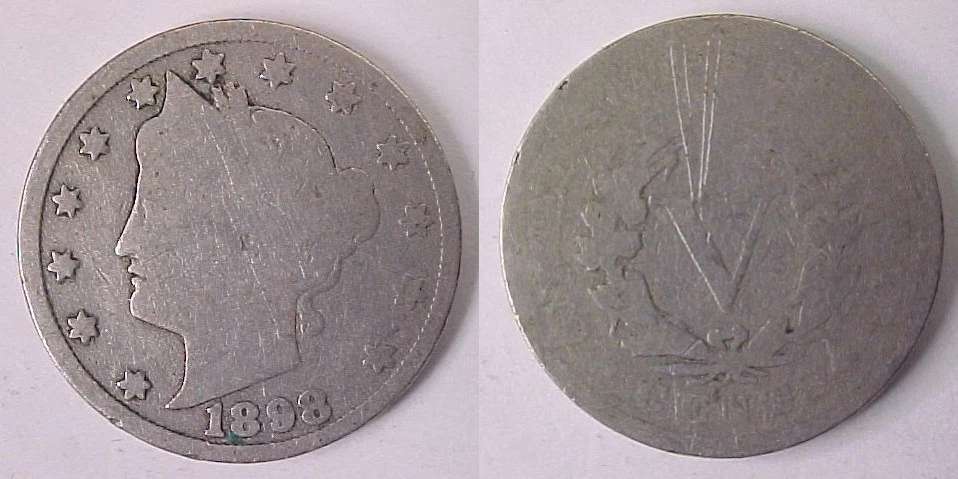
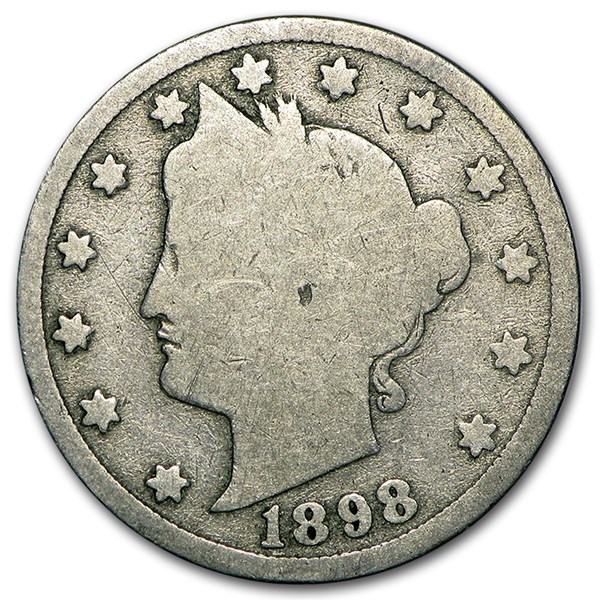
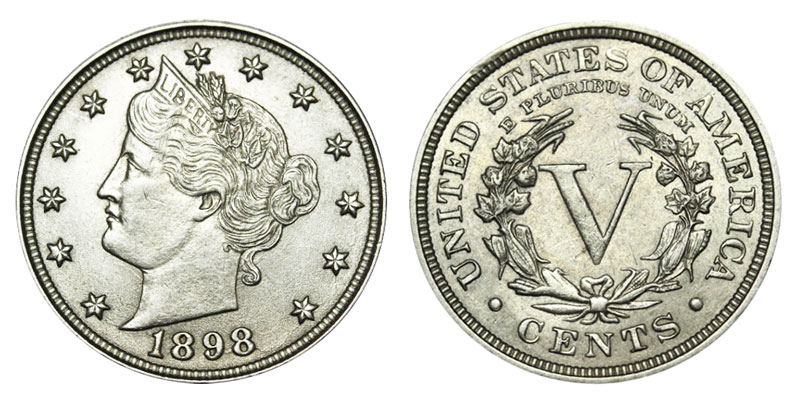
Heavy to moderate wear has smoothed the high points of Liberty's portrait. In Good, only the outline of Liberty's head remains with the date visible and the rim intact. In Fine, all letters of LIBERTY are readable (though the "I" may be faint), hair detail above the ear begins to show, and the reverse wreath retains outlines. Value: $4–$20.
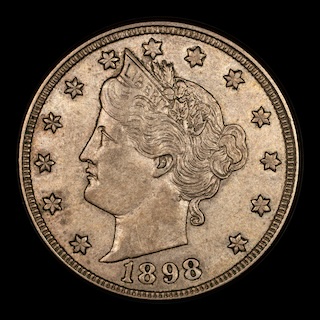
Very Fine examples show LIBERTY boldly, with more than half of Liberty's hair detail visible. Extremely Fine brings nearly all details out. About Uncirculated (AU-50 to AU-58) coins retain at least 50–90% of original mint luster in protected areas, with wear only on the absolute highest points (hair above the ear, the cheek, the corn ears). Value: $34–$131.
No wear anywhere — but lower Mint State grades (MS-60/61) may have heavy bag marks, impaired luster, or a weak strike. MS-62 to MS-63 coins should show good luster with only scattered contact marks in non-focal areas. The corn ear detail on the reverse wreath and Liberty's hair curls above the ear are the first places an experienced grader checks for any trace of rub. Value: $160–$250.
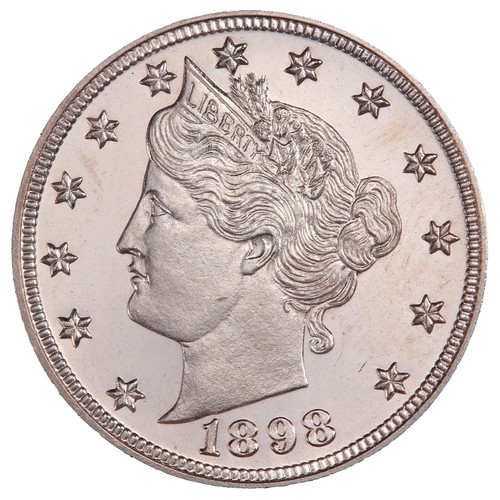
Gem-quality 1898 nickels require blazing original luster, minimal contact marks, and — critically — a sharp strike. The corn kernels on the lower-left reverse wreath must show distinct separation. Hair curls above Liberty's ear must be fully defined. Strike quality is often the deciding factor between MS-64 and MS-65. The solitary MS-67 example (top-pop at PCGS) brought $9,988 at auction. Value: $330–$675+ (MS-66: $1,500+).
🔬 CoinHix lets you photograph your coin and cross-check the condition against graded reference examples from your phone — a coin identifier and value app.
The right venue depends on your coin's grade and whether it has been certified. High-grade or variety coins deserve specialist channels; circulated examples sell fine locally or on eBay.
Heritage is the world's largest numismatic auction house and has handled dozens of 1898 Liberty nickel sales including MS-66 and MS-67 certified examples. For any coin grading MS-65 or above, or a proof example, Heritage should be your first call. Consignors typically receive 80–85% of the hammer price after buyer's premiums are accounted for. Schedule a submission review on their website.
eBay is the most liquid marketplace for circulated and mid-grade 1898 nickels. Look at recently sold 1898 nickel listings and completed sale prices to benchmark your asking price before listing. Uncertified coins typically sell for 20–40% below certified equivalents — consider a PCGS or NGC submission first if your coin grades MS-63 or better.
A reputable local dealer offers the advantage of an immediate cash offer and no shipping risk. However, dealers typically pay 50–70% of retail value to build in their margin. Best suited for worn and circulated examples where shipping and auction fees would eat into proceeds. Get 2–3 quotes before selling — dealer prices vary significantly.
Collector communities like r/coins4sale on Reddit or the PCGS message boards can connect you directly with Liberty nickel specialists willing to pay fair prices for attributed varieties. Particularly effective for RPD-001 and RPD-004 varieties that specialist dealers may overlook. Always use PayPal Goods & Services and ship insured when transacting with private buyers.
Plug in your mint, condition, and any errors for an instant estimate — it takes less than 60 seconds.
Get My Free Value Estimate →